Short answer: No, not as routine maintenance. A home split system is a sealed circuit, so it should keep its refrigerant for its whole life. If it is low, there is a leak. The fix is to find and repair the leak, pressure test, evacuate and recharge to the correct weight, done by an F-gas qualified engineer, not a top up.
Why everyone searches for “air con regas”
“Air con regas” is one of the most searched air conditioning terms in London, with Keyword Planner showing thousands of searches a month. Almost all of that is about cars. Car air conditioning uses flexible hoses, rubber seals and a compressor driven by the engine, all bouncing around on the road, so it slowly loses refrigerant and needs recharging every few years.
Home air conditioning is a different kind of system, and the same advice does not apply.
| Car air conditioning | Home split system | |
|---|---|---|
| Pipework | flexible hoses and rubber seals | copper pipes, flared or brazed joints |
| Movement and vibration | constant | fixed in place |
| Gradual refrigerant loss | expected over years | should not happen |
| Routine regas | common | not normal |
| Low refrigerant means | wear over time | a leak to find and fix |
| Who can work on it | trained technicians | F-gas qualified engineers, certified company |
Why a home system should hold its charge
When a split system is installed, the engineer joins the indoor and outdoor units with copper pipes, pressure tests the joints, pulls a vacuum to remove air and moisture, and then releases the refrigerant that is stored in the outdoor unit, adding more if the pipes are long. Done properly, that circuit is sealed. The refrigerant goes round and round and is not used up.
So if a home system is low on refrigerant, it has lost it through a leak. The common places are:
- flare joints at the indoor or outdoor unit, if they were not made or tightened correctly
- service valves on the outdoor unit
- damaged pipes, for example from drilling, building work or vibration
- corroded coils, more common on older units or in exposed positions
Why a top up is the wrong answer
Topping up without finding the leak means paying for refrigerant that will escape again, and the system will run poorly in the meantime. It also releases a greenhouse gas into the atmosphere. Refrigerants are fluorinated gases, and the law controls who handles them. Under the UK F-gas rules, anyone working on the refrigerant circuit of stationary air conditioning must hold a personal F-gas qualification, and their company must hold F-gas certification from an approved body. Gov.uk lists Refcom, the F-Gas Register (Quidos) and Bureau Veritas.
The right repair
A proper repair usually goes like this:
- Confirm low refrigerant using pressure and temperature readings.
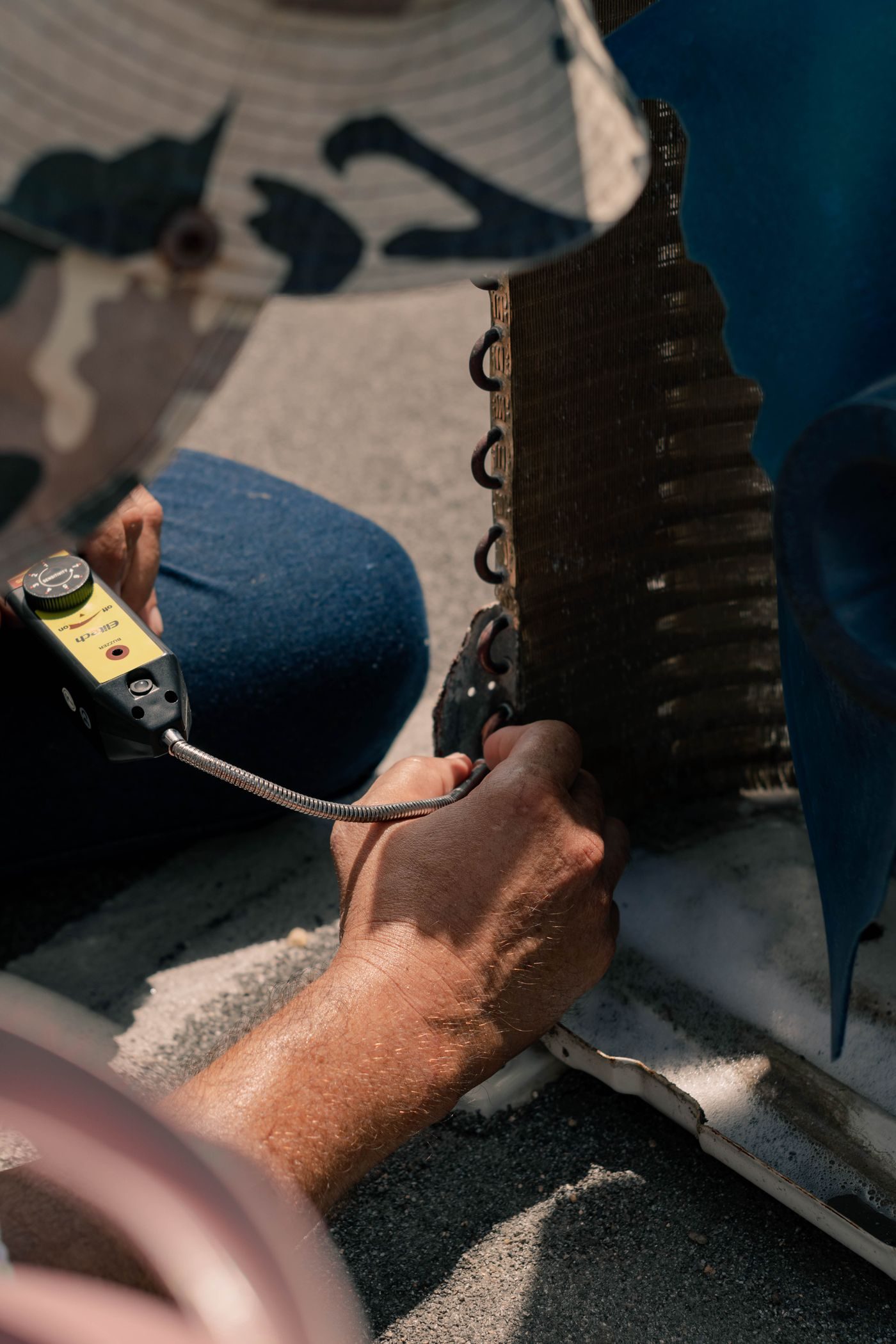
- Find the leak with an electronic detector, bubble solution or a pressure test with nitrogen.
- Recover any remaining refrigerant safely if the circuit needs opening.
- Repair the joint, valve or pipe.
- Pressure test the circuit to prove it holds.
- Evacuate with a vacuum pump to remove air and moisture.
- Recharge to the weight specified by the manufacturer, allowing for pipe length.
- Test the system in cooling and heating.
This takes longer than a quick top up, and it is the version that lasts. Our air conditioning repair page explains how a diagnosis visit works.
What it might cost
There is no single price, because it depends on where the leak is, how easy the units are to reach, how much refrigerant is needed and which refrigerant the system uses. On a Fulham terrace with the outdoor unit on an extension roof, access is usually straightforward. On a high bracket or a mansion block roof, it takes longer. The price should be explained after diagnosis, before the repair. See our Hammersmith and Fulham page for the type of installs common locally.
When an old system is not worth regassing
Some older systems use refrigerants that are being phased down, such as R410A, or much older ones. If an old unit has a major leak in its coil, or other parts are failing, replacement may make more sense than repair. A new system using R32 is likely to be more efficient and quieter. Our guide to R32 refrigerant explains the difference.
Signs to watch for
- cooling or heating that gets weaker over weeks
- ice on the copper pipes or indoor coil
- hissing or bubbling sounds near the units
- the outdoor unit running constantly without reaching temperature
- oily marks around pipe joints, since refrigerant carries oil
If you notice any of these, switch the system off and book a check. Running a system that is very low on refrigerant can damage the compressor.
Leak checks and the law
For larger systems, leak checking is a legal duty. Gov.uk says equipment containing F gas equivalent to 5 tonnes of CO2 or more must be checked for leaks at set intervals, with records kept (gov.uk). Most single room home systems hold much less than that, so for them leak checking is part of good servicing rather than a legal requirement. Larger multi split systems and office systems can pass the threshold.
Either way, a yearly service is the best way to catch a slow leak early. During a service, the engineer can check pressures and temperatures, look for oil marks at joints and spot weak cooling before it becomes a breakdown. Our servicing page explains what is included.
Quick questions
How often does home air conditioning need regassing?
It should not need regassing at all if it was installed properly and has no leaks. A need for regular top ups is a sign of a leak that has not been fixed.
How do I know if my air conditioning is low on gas?
Signs include weak cooling or heating, ice on the pipes or indoor coil, and the outdoor unit running for long periods. An engineer confirms it by measuring pressures and temperatures.
Can I buy refrigerant and regas it myself?
No. Handling refrigerant in stationary air conditioning requires an F-gas qualification, and companies doing it need F-gas certification. Releasing refrigerant is also harmful to the climate.
Last updated 23 October 2026. Written for homes in London. Rules can change, so check the linked sources for the latest position.